The Parish of St. Bede, Newsham and St. Mary the Virgin Horton
All are Welcome
St. Bede's, Newsham and St. Mary's Horton are open for Public Worship.
St. Bede's Facebook - Click Here
Local contacts available to speak to if you have any safeguarding concerns
Parish Safeguarding Officer
Janet Beecroft
07514561562
Janetbee2002@yahoo.co.uk
Diocesan Safeguarding Caseworker
Jill Thirlaway
safeguarding@newcastle.anglican.org
St. Mary the Virgin, Horton
The earliest mention of a chapel at Horton, in the Parish of Woodhorn occurs in the confirmation of various churches and chapels by Bishop Pudsey of Durham, to Tynemouth Priory in the year 1174. The chapel of Horton was part of the Parish of Woodhorn. In the early half of the thirteenth century the chapel was stated to be worth 50 marks yearly.
Those parishioners who attended divine service in the chapel for a whole year had rights of baptism and burial in it.
In 1249 Bishop Kirkham of Durham granted the church to Tynemouth Priory for as long as the Rector Master Roger de Cantilupe was there. Upon condition that the Prior should endow a vicarage. The endowment was made before 1254 as the vicarage was included in Pope Innocent’s Valor. However, it appears that the Prior and Convent conferred the tithes on the vicar of Woodhorn.
In 1650, Horton became a Parish and was Mother Church to the chapels at Cramlington, Newsham and Blyth Neuk. It remained part of the greater parish of Woodhorn until 1768 when it finally separated. At this time the church was dedicated to St. Mary the Virgin.
A manuscript tour of Northumberland made in 1770 states that the church seems to have been formed from the middle aisle of a Saxon church, some of the circular arches, of which remained. The original chapel had a north aisle of and was of Norman date, but this was subsequently demolished and the three arches that divided it were walled up. The medieval chapel was taken down in 1827 and present church was erected at a cost of £400. There are some remains of the original Saxon church, a sarcophagus and a broken capital are outside by the south wall. Inside of the porch, set above the door, is a 12th century tympanum with a diaper pattern. The bell tower dates to 1621.
Current furnishings and fittings are mostly from 1903, when the church was remodelled by W.S. Hicks. In 1950 the church was listed on the National Heritage for England list as Grade II, a building of architectural and historic interest.
Points of interest inside of the church include the mosaic floor in the sanctuary and the East window showing the Virgin Mother and Child. The arch behind the choir stalls on the north side is considered to be original. The statue of the Virgin Mary in one of the south window recesses was bought by Fr Alan James in memory of his mother. They had been the last family to live in the vicarage.
Points of interest outside of the church include a beam set in the south wall in memory of Anne Harbottle, 1517 and the sundial, put in by the churchwardens in 1827
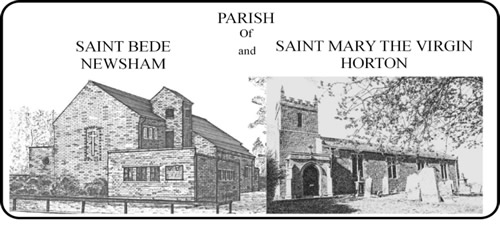
St. Bede, Newsham
The story of Saint Bede’s began when the Vicar of Horton appointed a curate to look after New Delaval and Newsham in 1885. This was the Rev’d David Bryson, who realized that while the free churches had built chapels in the village, Anglicans were expected to walk across the fields to the Parish Church of St Mary, Horton. He approached the owners of the Richard and William Pits, the Seaton Delaval Coal Company, who donated the necessary bricks and building materials, and a piece of land at the west end of Middle Row and North Row in New Delaval Colliery (now Blyth Golf Course). This was dedicated on 15th February, 1892, and was of a similar design to St Andrew’s Cambois and St Michael’s New Hartley, which are still standing.
By 1920 the church proved to be inadequate, and the congregation moved to an army hut on Newcastle Road, almost opposite land donated by Lord Ridley for the construction of a new church. The original building continued to serve as a church hall, until the new church and parsonage (now the Parish Centre and Vicarage) were completed in 1930. The bricks from the original church were used on the internal walls of the new buildings. In 1931 a declaration of the King in Council established Newsham as a “conventional district” within the Parish of Horton, and its curate became a “priest-in-charge.” During the Second World War the choir vestry was requisitioned by the Air Raid Prevention and Father Graham became an A.R.P. warden.
After the war it was felt that St Bede’s was ready to become an independent parish, but it wasn’t until December 14th, 1957, that the present Parish Church was consecrated, and Father Luxmoore (later Bishop of Bermuda) became the first Vicar of Newsham.
Very few items from the first church remain. The original altar cross is used in the chapel of a local funeral director. The original statue of Our Lady is still carried in procession on Our Lady’s feasts. A small plaque of the Mother and Child can still be found in the present Lady Chapel. The original tabernacle veil now serves as a pulpit fall.
The original portable font, so necessary in the days of home births and high natal fatalities, is now the holy water stoup.
From 1957 the “third church” continued in use as a church hall. In 1991 it was refurbished to become a modern parish centre, and in 2004 it was improved and extended, with the help of a grant from the National Lottery Community Fund, to improve our facilities for the disabled. In 2002 a ramp for the disabled was added to the church to commemorate the Golden Jubilee of Her Majesty the Queen.
During 2018 there were some changes within the Parish boundaries in Blyth, which resulted in the areas covered by the churches of St. Mary the Virgin, Horton and St. Bede, Newsham becoming one Parish, with one Parochial Church Council.